Module 01Decision
Mission rules & playbooks
Codify doctrine and rules of engagement as signed, versioned decision logic. Every recommendation is deterministic, explainable and logged to an immutable audit trail.
Systems / What we build
ARES, our flagship, runs C2 and ISR decision support at the tactical edge. ICARUS is a full-spectrum intelligence platform across OSINT, GEOINT, SIGINT and MASINT. Both are built from the same open modules, and both assume the link will not be there.
01 / Overview
ARES and ICARUS are the two systems. Beneath them sit shared modules: inference, fusion, decision logic and interoperability. The modules meet at published, versioned interface contracts, and conformance is validated in software. This is a Modular Open Systems Architecture (MOSA). A radio adapter, an offline model or a fusion sink can be replaced, re-competed or second-sourced without changing the modules on either side of the interface.
System 01 / Flagship · C4ISR
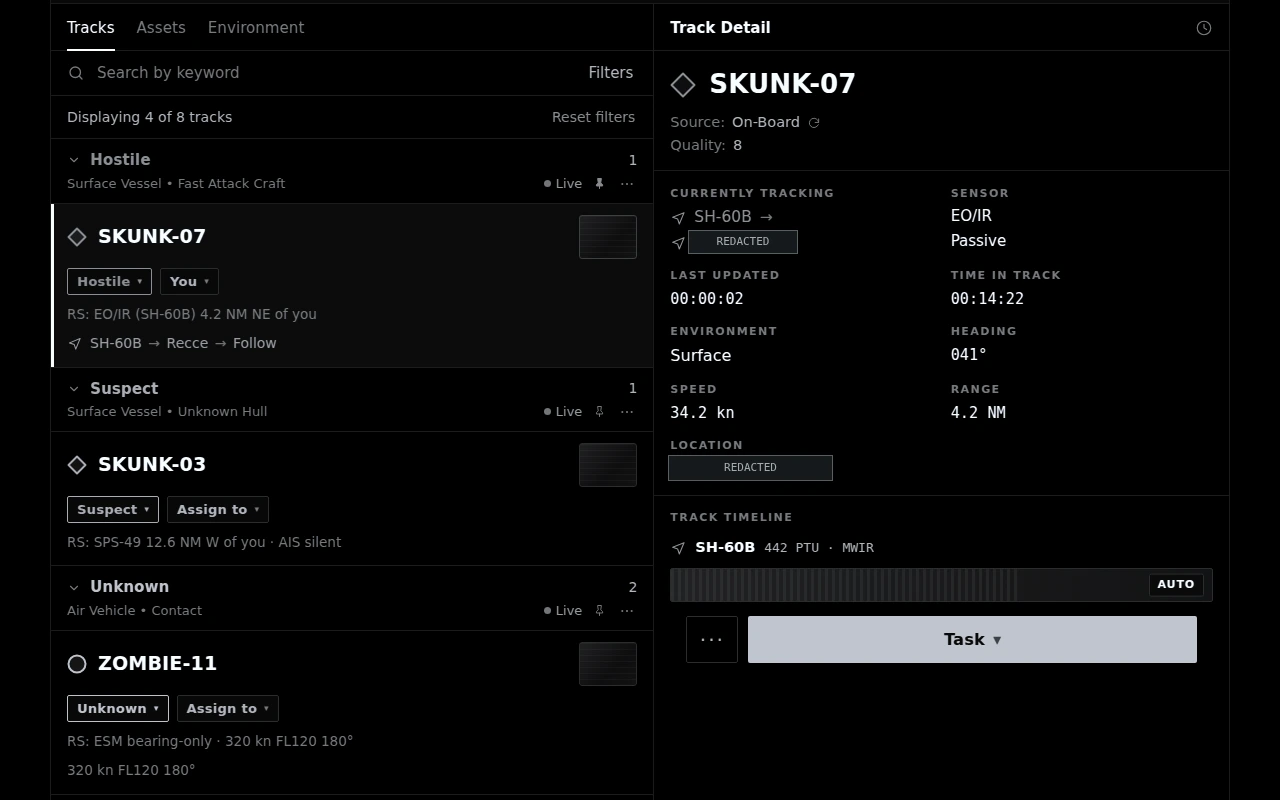
ARES is Hyperborea’s flagship: mission middleware that turns a fused tactical picture into staff-level recommendations. It bridges Link-16, MIL-STD-1553 and CoT/ATAK to on-node inference on Jetson Orin-class compute, and runs a multi-agent C2 staff (ISR, EW, fires and sustainment) that reasons at machine speed while a human holds release. It plans fires, ISR collection, manoeuvre and counter-UAS from fireteam to company echelon, carries the F2T2EA targeting loop, and holds a PACE plan for comms fallback. Built for air-gapped, GPS-degraded and EW-contested operation.
ARESSpecification
ICARUSSpecification
System 02 / Full-spectrum intelligence
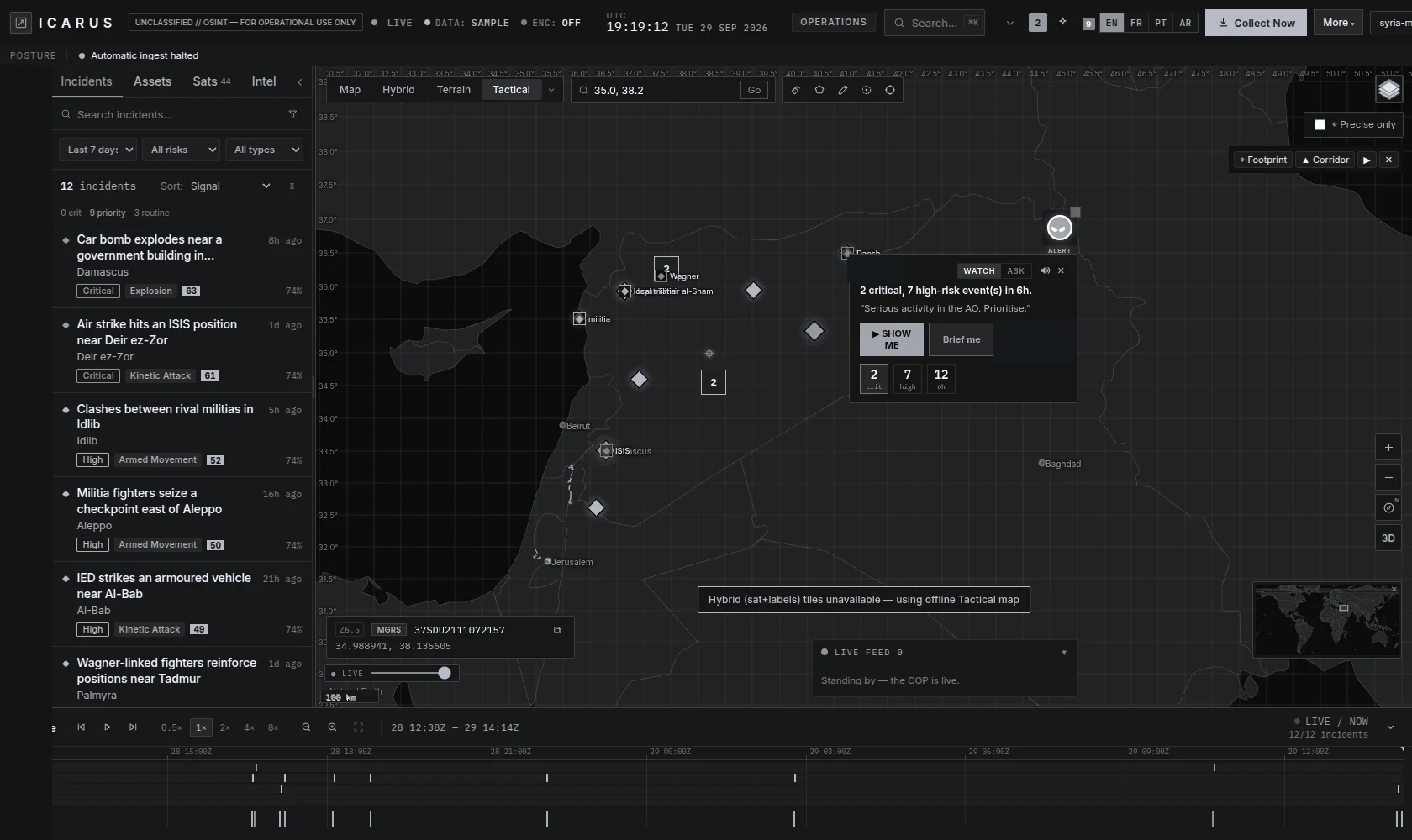
ICARUS is a full-spectrum intelligence platform. It fuses worldwide OSINT, multi-INT sensor networks and AI-driven analysis into one deployable stack, then scores what it finds into warnings against the priority intelligence requirements the customer sets. Collection and analysis are described here; ICARUS’s operational reach is covered under briefing. Standalone by design: it replaces a rack of third-party tools rather than orchestrating them. Deploys on-premise.
02 / Platform modules
Six modules, shared by both systems and published as versioned interface contracts. Conformance is checked rather than asserted, and the sensor-side interfaces follow the SOSA catalogue, the classes a programme office requires so a module can be re-competed.
The platformModule 01Decision
Codify doctrine and rules of engagement as signed, versioned decision logic. Every recommendation is deterministic, explainable and logged to an immutable audit trail.
Module 02Inference
Language models and retrieval running entirely on your own hardware, with no cloud and no egress. Operators query doctrine, mission data and live feeds in natural language, fully air-gapped.
Module 03Fusion
Fuse radar, ADS-B, AIS, RF and reporting into a single deduplicated track picture, with threat evaluation and engagement support for a shared, real-time view of the battlespace.
Module 04Collection
Worldwide ingestion across OSINT, multi-INT sensors, radio, imagery and satellite, then corroborated, geolocated and de-duplicated into ranked warnings with geofenced, real-time alerting. Built in-house end to end, with no third-party tooling in the pipeline.
Module 05Interop
Native tactical data link and bus interop, bridged across classification boundaries by a one-way cross-domain guard: Link-16 (STANAG 5516), HF data link (STANAG 5066), UAS control (STANAG 4586), motion imagery (STANAG 4609), MIL-STD-1553 and CoT/ATAK.
Module 06Resilience
Peer-to-peer meshing keeps nodes in sync across degraded and intermittent links. Each node operates fully autonomously when comms drop, then reconciles state on reconnect.
03 / Field-hardened
Systems are built signed and reproducible, run on rugged edge hardware and maintain a full audit trail throughout, designed to degrade gracefully as links, power or bandwidth are lost, rather than failing closed.
That behaviour is exercised hardware-in-the-loop on real handsets, radios and edge compute, not a bench simulation standing in for them. Current status.
We walk through the architecture, the assurance model and the integration surface with your engineering team.
Request briefing